
Build Your Personal “Exam Roadmap”: A Template for Any Subject
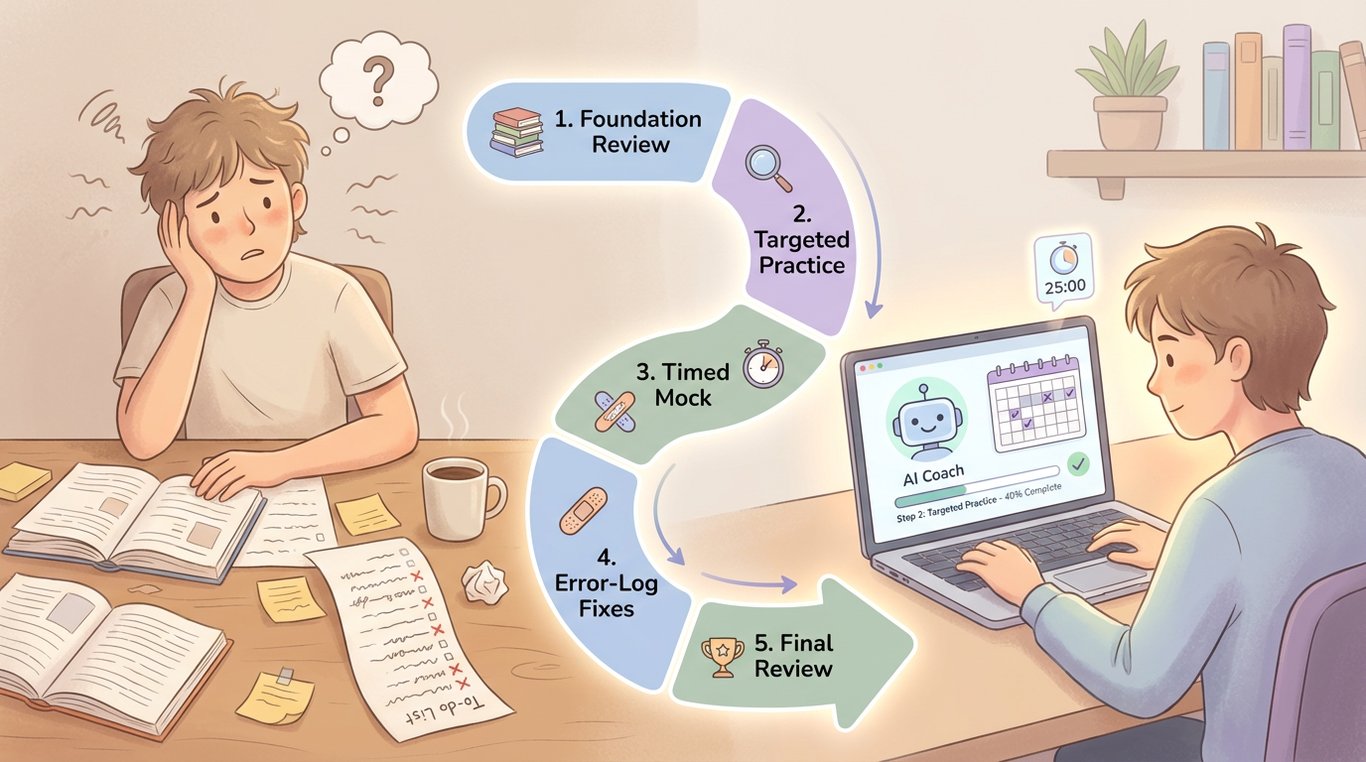 If your to-do list looks like a horror movie right now, take a breath.
You do not need a perfect study plan.
You need a roadmap.
Not a giant color-coded masterpiece you’ll abandon in two days. Not a vague promise to “revise more.” A real roadmap: simple, repeatable, and clear enough that you know what to do next.
Because most students don’t fail from lack of effort. They fail from studying in the wrong order, too randomly, or too late.
Here’s the fix.
The 5-step exam roadmap
No matter what subject you’re studying—Maths, Languages, Sciences—the structure is basically the same:
Foundation review
Targeted practice
Timed mock
Error-log fixes
Final review
That’s the system.
Think of it like building a house:
foundation first
stress-test it
fix the cracks
do the final polish
In other words: don’t start with panic. Start with sequence.
Why this order works
A lot of students revise backwards.
They jump straight into past papers, get destroyed, lose confidence, then spend hours “reviewing” by rereading notes they don’t remember.
That’s not a roadmap. That’s academic pinball.
A better system follows dependencies:
You review the basics before expecting speed.
You practice specific weak areas before full mocks.
You do mocks before final review so you know what still needs work.
You fix mistakes before exam week so the final review is actually light.
This is the key idea: each stage unlocks the next.
Step 1: Foundation review
This is where you rebuild the floor under your feet.
Your job here is not to master every tiny detail. It’s to make sure you’re not walking into practice sessions with giant knowledge gaps.
What to do
List the major topics in the subject
Mark each one:
solid
shaky
basically foreign language
Review core concepts, formulas, vocabulary, methods, or definitions
Keep it active:
blurting
flashcards
summary sheets from memory
teaching it out loud
basic questions
What this looks like in practice
Maths
algebra rules
equation solving
key formulas
common methods by topic
Languages
core vocabulary
high-frequency grammar
verb conjugations
essay/speaking structures
Sciences
core processes
equations
required practicals
definitions and diagrams
Start date
Start this first, ideally 3–6 weeks before the exam, depending on how much content you’ve forgotten.
If you’re late? Fine. Start now, but compress it.
Dependency
Foundation review must happen before targeted practice.
Why? Because practice only helps if you understand what you’re practicing.
Step 2: Targeted practice
Now we stop “studying everything” and start attacking what actually loses you marks.
This is where improvement happens fast.
What to do
Choose weak topics from Step 1
Do focused question sets on those topics
Review answers immediately
Note patterns:
careless mistakes
method errors
memory gaps
timing issues
The goal is not just “do more questions.”
The goal is: do the right questions, then learn from them.
What this looks like in practice
Maths
15 questions only on simultaneous equations
20 minutes on probability tree diagrams
one mixed set on weakest three topics
Languages
one listening drill on numbers/dates
one grammar set on past tense
one timed paragraph using target vocabulary
Sciences
calculation questions only
data-analysis questions from practicals
short-answer drills on weak units
Start date
Begin this right after your first foundation pass, usually 2–4 weeks before the exam.
Dependency
Targeted practice depends on foundation review.
And timed mocks depend on at least some targeted practice.
Don’t wait until every weak area is fixed. Just don’t jump into mocks completely cold.
Step 3: Timed mock
This is the reality check.
Not the fun kind. The useful kind.
Timed mocks show you what happens when knowledge, pressure, and time all collide. That matters, because being “good at revision” is not the same as being ready for the exam.
What to do
Sit a past paper or mock section under timed conditions
No notes
No pausing every 4 minutes
Mark it honestly
Record what went wrong
What this looks like in practice
Maths
one full calculator paper on Sunday morning
one 30-minute no-calculator section midweek
Languages
one reading paper timed properly
one speaking response practiced under realistic time pressure
one essay written with actual exam timing
Sciences
one full paper
or one paper split into timed sections if stamina is an issue
Start date
Usually 1–3 weeks before the exam, after you’ve done enough targeted practice to make the mock meaningful.
Dependency
Timed mocks depend on foundation review + targeted practice.
Because a mock is a diagnostic tool, not a substitute for preparation.
Step 4: Error-log fixes
This step is where most students level up—and where most students quit too early.
They do the mock, look at the score, feel something between dread and denial, then move on.
Big mistake.
Your mock score is not the lesson.
Your error log is the lesson.
What to track
For every mistake, write:
the topic
what kind of mistake it was
why it happened
what to do next
Here’s a simple error log format:
Question | Topic | Mistake type | Why it happened | Fix |
|---|---|---|---|---|
Q4 | Quadratics | Method error | Forgot factorising steps | Redo 10 similar questions |
Q7 | French writing | Vocabulary gap | Didn’t know travel phrases | Learn 15 travel terms |
Q2 | Biology | Definition weakness | Mixed up key terms | Make flashcards and self-test |
Mistake types to use
knowledge gap
method error
misread question
timing issue
careless mistake
exam technique problem
Start date
Immediately after every mock.
Not “later in the week.”
Not “when I have time.”
Right after.
Dependency
Error-log fixes depend on timed mock results.
And final review should depend on error-log fixes.
Because the whole point of a final review is confidence—not re-discovering your problems at the last second.
Step 5: Final review
This is the calm, sharp, last pass.
Not cramming six chapters at 1 a.m.
Not trying to learn brand-new content the night before.
This is about tightening recall, revisiting common mistakes, and walking into the exam knowing what matters most.
What to do
Review your error log
Revisit summary sheets / flashcards
Skim high-yield topics
Do a few confidence-building questions
Review exam strategy:
timing
question order
checking method
common traps
What this looks like in practice
Maths
formulas
top 10 mistake patterns
5 quick mixed questions
Languages
key vocab lists
essay structures
speaking openers
tense reminders
Sciences
equations
required practicals
command words
hardest definitions
Start date
Usually 1–3 days before the exam.
Dependency
Final review depends on your error-log fixes being done.
That way final review feels like reinforcement, not chaos control.
The full roadmap at a glance
Here’s the template:
Stage | Purpose | Best start date | Depends on |
|---|---|---|---|
Foundation review | Rebuild core understanding | 3–6 weeks before exam | None |
Targeted practice | Improve weak topics fast | 2–4 weeks before exam | Foundation review |
Timed mock | Test under pressure | 1–3 weeks before exam | Foundation + targeted practice |
Error-log fixes | Turn mistakes into action | Right after each mock | Timed mock |
Final review | Tighten recall and confidence | 1–3 days before exam | Error-log fixes |
That’s your exam GPS.
And remember: a GPS is there to guide you, not shame you. If you miss a day, reroute. Don’t self-destruct.
How to use this for any subject
1. Maths roadmap
Maths is skill-heavy, so the roadmap leans hard on practice + error correction.
A simple flow:
Foundation: methods, formulas, topic basics
Targeted practice: weakest question types
Timed mock: full paper
Error-log fixes: redo wrong methods
Final review: formulas, traps, confidence questions
Example
If algebra and geometry are weak:
Week 1: review algebra rules and geometry facts
Week 2: do topic drills on both
Weekend: timed paper
Next 2 days: log and fix mistakes
Final 2 days before exam: quick recap
2. Languages roadmap
Languages need a mix of memory, structure, and performance under pressure.
A simple flow:
Foundation: core vocab, grammar, sentence builders
Targeted practice: weak tenses, listening gaps, writing drills
Timed mock: reading/listening/writing sections
Error-log fixes: patch vocab and grammar gaps
Final review: speaking phrases, high-frequency vocab, structures
Example
If you freeze in writing:
Foundation: learn 3 reliable paragraph structures
Targeted practice: write short answers using those structures
Timed mock: one full writing task
Error-log fixes: collect missing vocab and repeated grammar errors
Final review: memorise openers, connectors, endings
3. Sciences roadmap
Sciences are a blend of knowledge recall + application + exam technique.
A simple flow:
Foundation: topic summaries, equations, definitions
Targeted practice: calculations, data questions, weak units
Timed mock: full paper or paper sections
Error-log fixes: misconceptions, command words, missed steps
Final review: practicals, formulas, key definitions
Example
If chemistry calculations keep going wrong:
Foundation: mole basics, formula triangles, units
Targeted practice: 15 calculation questions daily
Timed mock: one paper section under time
Error-log fixes: note exactly where steps break down
Final review: equations and worked examples
What if real life is messy?
It is messy.
You’ve got school, homework, maybe a part-time job, training, family stuff, low energy, and that one afternoon you swore you’d study but somehow lost to your phone and a bag of cereal.
That’s why your roadmap needs to live in the real world.
A good study system should answer:
What should I do first?
When exactly will I do it?
What happens if I fall behind?
How do I know what’s working?
This is where a tool like AriaPlanner can help—not as magic, just as one way to make this easier.
How AriaPlanner can turn the roadmap into an actual system
The reason students get overwhelmed isn’t usually the roadmap itself. It’s the translation from:
“I know what I should do”
to
“I know what I’m doing at 6:30 p.m. on Tuesday.”
That gap matters.
1. Plan tab: build the roadmap with dependencies
In the Plan tab, you can map the exam into stages instead of dumping everything into one giant list.
For example, you might create:
GCSE Maths Exam
GCSE English Exam
Biology Final
Inside each plan, you can add tasks like:
Review algebra foundations
Practice quadratics set
Complete timed paper 1
Fix paper 1 error log
Final formula review
Then connect them with dependencies:
“Practice quadratics set” starts after “Review algebra foundations”
“Complete timed paper 1” starts after practice tasks
“Fix paper 1 error log” starts after the mock
“Final formula review” starts after error-log fixes
That matters because your plan stops being a wish list and starts behaving like a sequence.
Sample script
Tell Aria:
“I have a GCSE Maths exam in 3 weeks. Build me a plan with foundation review first, then targeted practice, then one timed mock, then error-log fixes, then final review. I’m weak at algebra and geometry.”
Or for languages:
“I have a Spanish exam in 2 weeks. Make a roadmap with vocab and grammar review first, then targeted writing and listening practice, then a timed mock, then error-log fixes, then a final review.”
That’s planning.
Clear. Structured. Less brain fog.
2. Schedule tab: fit it around your actual life
Now comes the part students skip.
A plan is useless if it doesn’t fit into reality.
The Schedule tab helps map those tasks onto actual open time around classes, work shifts, sports, and everything else. If you use Apple Calendar, that matters even more, because your study plan can sit alongside the life you already have.
Here’s what this looks like in practice:
Foundation review goes into shorter weekday blocks
Targeted practice goes into medium sessions after school
Timed mock gets placed on a weekend morning
Error-log fixes get scheduled the same day or next day
Final review gets lighter slots near exam day
That’s how you stop saying “I’ll revise sometime tomorrow” and start saying “I’m doing 40 minutes of chemistry calculations at 7 p.m.”
Huge difference.
3. Focus screen: actually do the work
Planning is nice. Doing is better.
The Focus screen is useful when you need help starting and staying with the task in front of you. The adaptive coffee cup timer gives your session a clear shape without making it feel robotic.
And if you finish early? Great. You’re not trapped. You can move on, end the session, or let the remaining work be rescheduled.
That sounds small, but it removes a lot of the all-or-nothing thinking that kills consistency.
Because the goal isn’t to become a productivity machine.
It’s to keep the loop going:
plan
schedule
focus
learn
adjust
4. Insights tab: review what’s actually happening
This is the part students almost never do on their own, and it’s why they keep repeating broken routines.
At the end of the week, check:
Which sessions got skipped?
Which subject keeps taking longer than expected?
Where are your low-energy times?
Are mocks exposing the same weak topics again and again?
The Insights tab can help you reflect on patterns and coaching notes, so your plan improves instead of just getting longer.
That’s the learning loop.
Not just “study harder.”
Study smarter, then adjust.
A simple weekly structure you can steal
If you want a starting point, use this:
3–6 weeks before exam
3–5 foundation review sessions per week
2–3 targeted practice sessions
start building topic lists and weak areas
2–3 weeks before exam
reduce pure review
increase targeted practice
add first timed mock
create error log after each mock
final week
1–2 more timed sections or mocks if helpful
mostly error-log fixes
short final reviews
lighter sessions the day before
Simple. Repeatable. Flexible.
Your exam roadmap template
Copy this:
Exam: [subject]
Exam date: [date]
Phase 1: Foundation review
Topics to review:
Resources to use:
Start date:
Finish date:
Phase 2: Targeted practice
Weak topics:
Question sources:
Start date:
Finish date:
Phase 3: Timed mock
Mock date:
Paper/source:
Time conditions:
Phase 4: Error-log fixes
Common mistakes:
Fix tasks:
Start date:
Finish date:
Phase 5: Final review
Key facts/formulas/vocab:
Confidence topics:
Final review date:
Rules
Targeted practice starts after foundation review
Timed mock starts after at least 2–3 targeted practice sessions
Error-log fixes happen within 24 hours of a mock
Final review happens after error-log fixes
That’s it.
Not fancy. Effective.
Final thought
Your study plan should feel like a GPS, not a prison.
It should tell you where to go next.
It should reroute when life gets messy.
It should help you focus on the work that moves your score.
And if your workload currently feels like a pile of loose papers, half-finished intentions, and low-grade panic, that doesn’t mean you’re lazy or bad at studying.
It means you need a better system.
This 5-step roadmap is one.
And AriaPlanner is one way to make that system easier to build, schedule, follow, and adjust.
Start small.
Make the next step obvious.
Then keep going.
That’s how students get out of chaos.
And yes—you can absolutely do that too.