
Focus Sessions That Don’t Drain You: The Science of Stopping at the Right Time
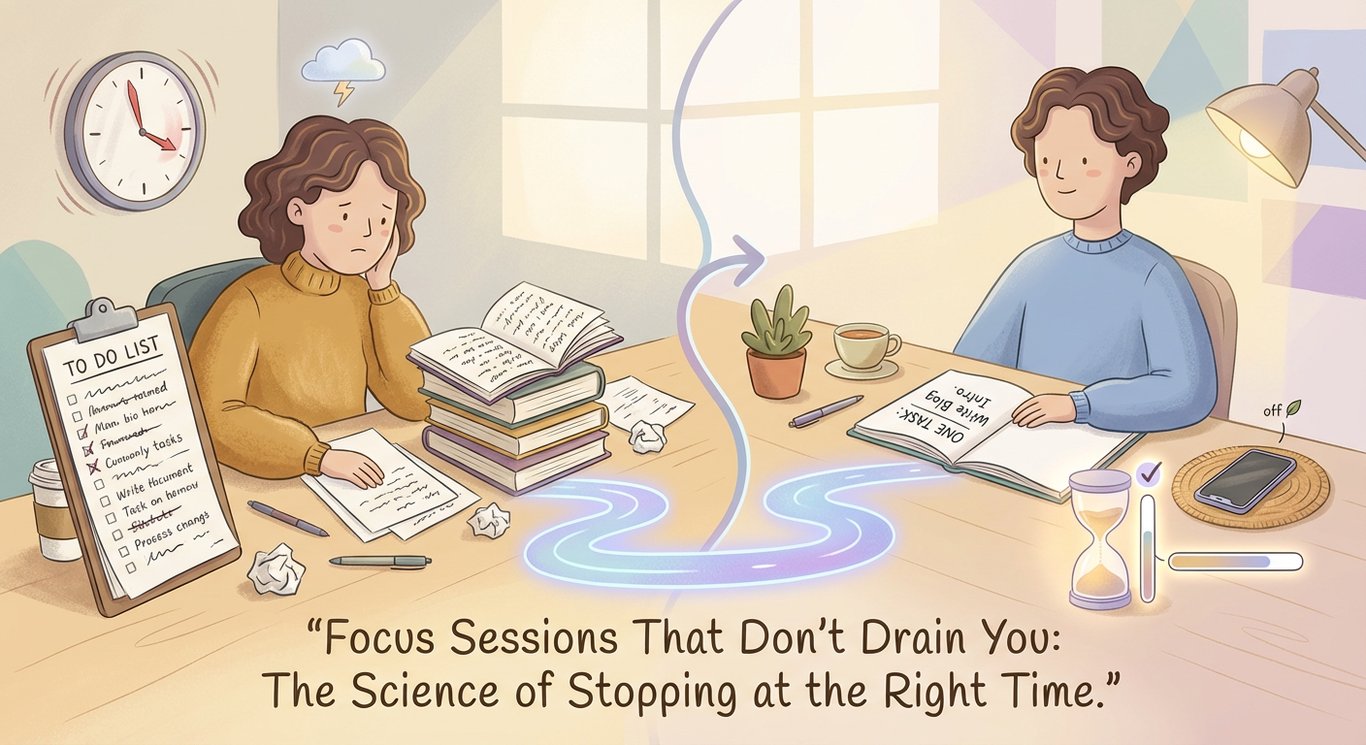 If your study sessions always end with your brain feeling like a burnt piece of toast, we need to talk.
vA lot of students have been taught the same bad rule: if you’re tired, push harder. Sit there longer. Force another hour. Keep staring at the page until something magical happens.
But that’s not discipline.
That’s usually just bad timing.
The truth is, focus is not endless. Your brain is not a machine that gets better just because you keep it switched on longer. After a certain point, the quality drops. You read the same sentence five times. You highlight everything. You copy notes without processing them. You feel busy, but not effective.
That’s cognitive fatigue.
And if you ignore it, “just push through” often backfires.
Why pushing through stops working
Cognitive fatigue is what happens when your mental resources get drained. Attention gets sloppy. Working memory gets weaker. Decision-making gets slower. You start making simple mistakes or avoiding harder tasks because your brain wants relief.
Here’s what this looks like in real life:
You sit down to revise biology for 90 minutes
The first 35 minutes are solid
The next 20 are okay
The last 35 are basically you opening tabs, rereading headings, and questioning your life choices
That last chunk feels productive because you were technically studying.
But it probably wasn’t your best work.
That’s the trap: time spent and quality of focus are not the same thing.
Think of focus like sprinting, not like leaving a tap running. More time does not automatically mean more output. Sometimes it just means more friction.
The goal is not longer sessions. It’s better stopping.
A lot of students ask, “What’s the perfect study session length?”
Annoying answer: it depends.
Because the right session length changes based on:
the subject
the difficulty of the task
how much sleep you got
your stress level
how familiar the material is
whether you’re solving problems or just reviewing
how distracted or mentally cooked you already are
This is why rigid study advice can be so unhelpful. A fixed 2-hour block might work great for essay planning on one day and be a complete disaster for physics problems on another.
What works better is adaptive session length.
In plain English:
You don’t force every focus block to be the same. You adjust based on the task and your actual brain.
That’s how you protect your energy and get more done.
A better rule: use stopping rules
Instead of asking, “How long should I sit here no matter what?” ask:
Am I genuinely done?
Am I still making progress?
Am I stuck enough that continuing is wasteful?
That’s where two simple stopping rules come in:
1. Finish Early
If you completed the goal of the session properly, stop.
Yes, even if the timer hasn’t run out.
A lot of students accidentally train themselves to equate “good studying” with suffering for the full block. So if they planned 50 minutes but finished the task well in 32, they start dragging the session out with fake work.
Don’t do that.
If the goal was:
finish 12 calculus questions
memorize 20 key terms
outline one essay
review one flashcard deck
…and you actually did it with full attention, you’re done.
Stop. Take the win. Move on.
That protects energy for the next session instead of wasting it because you feel guilty ending early.
2. Reschedule
If you are properly stuck, stop pretending more minutes will magically fix it.
There’s a difference between:
normal effort discomfort, and
genuine unproductive stuckness
Normal effort discomfort sounds like:
“This is hard, but I can still think.”
“I need to slow down.”
“I’m not fluent yet, but I’m making progress.”
Unproductive stuckness sounds like:
“I have no clue what this question is asking.”
“I’ve reread this three times and still can’t start.”
“My brain is gone and I’m just clicking around.”
That’s your cue to reschedule, not spiral.
Rescheduling is not quitting. It’s making a smarter move:
switch to an easier related task
flag the topic to ask a teacher about
come back later with notes, a worked example, or more energy
shorten the session and restart after a break
That’s strategy. Not weakness.
Here’s what this looks like in practice
Let’s say you planned a 45-minute chemistry session after school.
But real life happened:
you had football practice
you still need to eat
your brain is half-dead
and you’ve got a maths quiz tomorrow too
Old system:
“Doesn’t matter. I said 45 minutes. I must suffer through all 45.”
Better system:
Start with a clear goal: “Complete 8 bonding questions and mark them.”
Work with full focus
At minute 28, you finish all 8 and understand your mistakes
You Finish Early
You use the extra time to rest or prep tomorrow’s maths session
That is a successful session.
Another example:
You start a history essay plan. After 20 minutes, you still can’t structure the intro because you don’t fully understand the source material.
Instead of sitting there for another hour feeling bad, you:
note the problem
reschedule the essay plan
switch to reviewing key quotes
ask for help tomorrow
come back with a better starting point
Again: successful session.
Because the goal is not to look busy.
The goal is to keep the planning → scheduling → focusing → learning loop working.
Think of your study plan as a GPS, not a prison
This matters a lot.
A good study system should guide you, not trap you.
If your plan says, “Revise chapter 4 from 7:00 to 8:00,” that is not a blood oath. It’s a best guess. A starting route. If you finish early, great. If traffic hits and your brain stalls, reroute.
That’s why students do better with systems that connect the whole loop:
Planning: break big exam goals into smaller tasks
Scheduling: fit those tasks into your real week
Focusing: work in sessions that adapt to your energy and progress
Learning: reflect on what worked and adjust
When one part is missing, everything gets messier.
You either plan too vaguely, schedule unrealistically, focus badly, or never learn from the pattern.
Where a tool like AriaPlanner can help
AriaPlanner is one way to make this easier, especially if your workload currently looks like someone dropped ten subjects down the stairs.
The useful part is not “having an app.”
It’s having a system that helps you think clearly.
In the Plan tab
You can break a big goal into actual tasks instead of carrying around one giant panic sentence like “revise biology.”
For example:
Cell structure flashcards
Enzyme questions
Required practical review
Past paper section B
Mark mistakes and make error log
You can also separate multiple plans by subject, add dependencies, and set start dates.
So instead of chaos, you get sequence.
Here’s what this looks like in practice:
Tell Aria:
“I have a GCSE English exam in 2 weeks, a chemistry test next Friday, and football practice on Tuesdays and Thursdays. Break this into manageable tasks.”
That moves you from vague stress to visible steps.
In the Schedule tab
Now those tasks need somewhere to live.
Because a good plan that never reaches your calendar is just motivational wallpaper.
Scheduling means finding real slots around your actual life:
school
commute
part-time job
training
family stuff
the fact that you are, in fact, a human
A tool that maps tasks onto real time, and can work alongside something like Apple Calendar, helps you stop overpromising to yourself.
Not “I’ll do 6 hours on Sunday.”
More like:
4:30–5:00 chemistry questions
5:15–5:45 English quote review
7:00–7:25 maths corrections
That’s workable.
On the Focus screen
This is where adaptive session length becomes real.
Instead of treating every session like a prison sentence, you use a focus timer that responds to what’s actually happening. If the session is done, you finish early. If you hit a wall, you reschedule.
Even something small—like an adaptive coffee cup timer—can help make focus feel lighter and more human.
Not robotic.
Not guilt-based.
Just structured.
And that matters more than students think.
Because many people do not need “more motivation.” They need a cleaner decision-making system in the moment:
Keep going?
Stop?
Switch?
Come back later?
A smart focus coach can support that.
How to tell whether to keep going, finish early, or reschedule
Use this quick check mid-session:
Keep going if:
you are still solving, recalling, or writing
the work feels hard but possible
your mistakes are teaching you something
you can clearly answer: “What am I doing right now?”
Finish Early if:
the session goal is fully complete
you understand what you just did
continuing would just be filler
you’ve reached a clean stopping point
Reschedule if:
you’ve been stuck on the same point for too long
your attention has collapsed
you need missing information or support
you’re no longer doing meaningful work
That’s your decision tree.
Simple. Fast. Useful.
A script you can steal
If you freeze when deciding what to do, use this:
At the start of the session:
“My goal for this session is to complete one past paper section and review my mistakes.”
If you finish early:
“I completed the goal properly. I’m stopping here and saving energy for the next task.”
If you’re stuck:
“I’m not making meaningful progress. I’m rescheduling this and switching to the next useful step.”
This sounds small, but it matters. It replaces guilt with clarity.
The real productivity win
The students who improve fastest are usually not the ones who can brute-force the longest.
They’re the ones who learn how to:
notice when focus quality drops
define a session goal clearly
stop when the value is gone
adjust the plan without drama
review patterns and improve next week
That’s sustainable discipline.
Not “I studied until midnight and remember nothing.”
Not “I sat there for two hours so I can feel virtuous.”
Just consistent, honest, repeatable work.
That’s how you build momentum without frying your brain.
End-of-week reflection matters too
This is the part students skip, and it costs them.
If you keep having draining focus sessions, don’t just try harder next week. Study the pattern.
Ask:
Which subjects drain me fastest?
What time of day gives me the best focus?
When do I usually need shorter sessions?
What kind of tasks make me get stuck?
Did I over-schedule this week?
An Insights tab or weekly review system can help here. Not in a magical way. Just in a practical one. You start spotting patterns, writing coaching notes to yourself, and making better decisions next week.
That’s the learning part of the loop.
And that’s where a lot of confidence comes from: not from always feeling motivated, but from knowing you can adjust.
Final thought
You do not get extra marks for unnecessary suffering.
Read that again.
A good focus session is not the one that leaves you wrecked. It’s the one that moves the work forward and leaves enough energy to come back tomorrow.
So the next time you study, don’t ask:
“How long can I force myself to sit here?”
Ask:
“What does a useful session look like today?”
Then use the answer:
plan the task
schedule it realistically
focus with stopping rules
learn from the pattern
That’s how you make studying feel less like chaos and more like a system.