
From “Hours Studied” to “Progress Made”: Better Metrics for Students
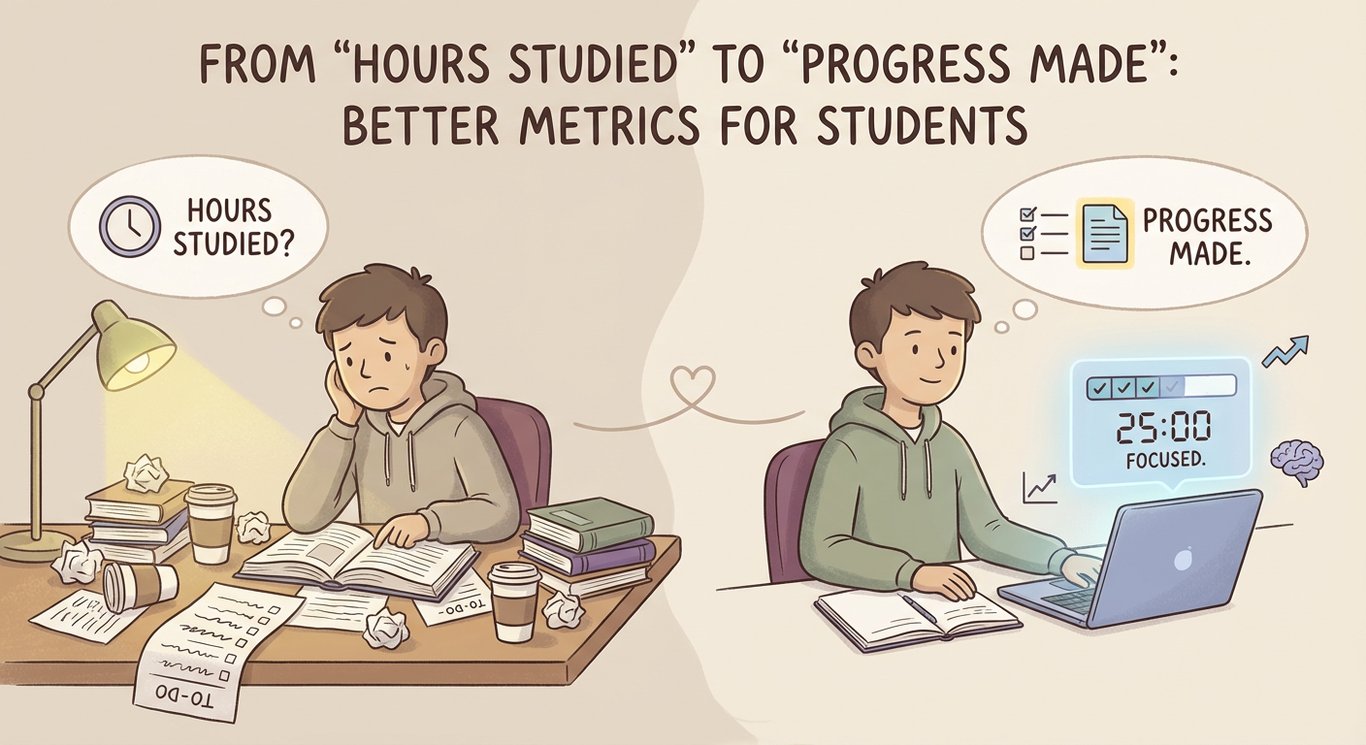 If your to-do list looks like a horror movie right now, let’s start with one truth:
“I studied for 5 hours” is not the flex you think it is.
I know that sounds harsh. But it matters.
Because hours studied is one of the most misleading metrics students use. It feels productive. It sounds disciplined. It looks good in your head when you’re trying to convince yourself you’re getting somewhere.
But time is not the same thing as progress.
You can sit at your desk for three hours and spend half of it rereading notes, checking your phone, and highlighting things you already understand. Meanwhile, someone else does 45 focused minutes, fixes two weak topics, completes one practice set, and walks away genuinely better than they were before.
That’s the difference.
The goal is not to track how long you looked busy.
The goal is to track what actually moved.
The problem with “hours studied”
Time is a vanity metric.
A vanity metric is something that looks impressive but doesn’t tell you much about real results. It’s like judging a workout by how long you stayed in the gym instead of whether you got stronger.
Students fall into this trap all the time because hours are easy to count.
2 hours of revision
4 hours in the library
6-hour study day
Okay. But what happened in those hours?
Did you finish the essay plan?
Did you master simultaneous equations?
Did your error rate in chemistry calculations improve?
Did you finally understand the thing that’s been confusing you for two weeks?
That’s what matters.
Especially if your real life is full. Exams, part-time shifts, sports practice, commuting, family stuff, low-energy days, procrastination spirals. In that world, you need a study system that rewards movement, not just seat time.
Better metrics: what students should track instead
Here’s the shift:
Instead of asking, “How many hours did I study?”
Ask, “What progress did I make?”
Here’s what this looks like in practice.
1. Tasks completed
This is the most immediate upgrade.
Track:
number of revision tasks finished
number of past-paper questions completed
number of flashcard sets reviewed
number of essay plans built
number of chapters actively revised
This works because tasks are concrete. They force clarity.
“Study biology” is vague and useless.
“Complete cell division notes + 15 retrieval questions” is trackable.
That’s why planning matters first. Before you can measure progress, you need work broken into pieces small enough to finish.
In AriaPlanner, this is where the Plan tab helps. You can turn one giant, stressful goal into smaller tasks across subjects, give them start dates, and map dependencies so you’re not revising random things in the wrong order. One way to make this easier is to stop treating school like one massive blob and start building separate plans for each exam or unit.
For example, you could tell Aria:
“I have a GCSE English exam in 2 weeks. Break this into quote review, theme revision, essay plans, and timed practice.”
Now you’re not tracking “hours on English.”
You’re tracking completed steps. Much better.
2. Concepts mastered
This one is huge.
A lot of students confuse exposure with learning. Seeing a topic again does not mean you own it.
So track:
concepts fully understood
topics that moved from “confusing” to “confident”
subtopics you can now explain without notes
question types you can solve independently
This metric is more honest because it asks: Can you do it now?
For example:
Before: “I kind of get trigonometric ratios”
After: “I can solve right-triangle trig problems without help”
That is real progress.
A simple rating system works well here:
Red = I don’t understand this yet
Yellow = I partly get it but still make mistakes
Green = I can do it alone under pressure
Each week, your goal is not to make everything green overnight. That’s fantasy. Your goal is to move a few things from red to yellow, and yellow to green.
Small shifts count. A lot.
3. Error rate on practice sets
This is one of the best metrics no one talks about enough.
Because improvement is not just about volume. It’s about accuracy.
Track things like:
8/20 correct on algebra practice last week, 15/20 this week
5 calculation errors per set, now down to 2
essay feedback: weak analysis in 4 paragraphs, now only 1
missed 6 marks from misreading command words, now missed 2
This tells you whether your studying is actually changing performance.
And it also helps you diagnose problems.
If your score is low because you don’t know the content, that’s one issue.
If your score is low because you rush and misread questions, that’s a different issue.
If your score is low because you run out of time, that’s another.
Different problem. Different fix.
This is where students get stuck when they only track hours. Hours don’t tell you why you’re not improving. Error patterns do.
4. Consistency streaks
Now, I’m not saying consistency is everything. Life happens. People get tired. Weeks go off the rails.
But consistency still matters more than heroic study marathons.
So instead of glorifying one 9-hour panic session, track:
number of days you completed at least one meaningful task
number of focus sessions done this week
number of planned study blocks you actually kept
number of times you restarted quickly after falling behind
That last one matters more than people realize.
A good study system is not built on perfection. It’s built on recovery.
Think of your plan like a GPS, not a prison. If you miss a turn, the goal is not to cry in the car. The goal is to reroute fast.
5. Time per useful output
This one is underrated.
Time itself is not useless. It just shouldn’t be the main score.
Instead, connect time to outcome:
45 minutes to complete 20 flashcards properly
30 minutes to mark and review one practice section
50 minutes to write one essay introduction + two body paragraphs
25 minutes to fix mistakes from yesterday’s maths set
Now time becomes diagnostic, not performative.
You’re no longer saying, “I studied for 4 hours.”
You’re saying, “It took me 40 minutes to finish that task, and next time I can probably do it in 30 because I know the process.”
That’s smart.
The planning → scheduling → focusing → learning loop
This is where a lot of students struggle. Not because they’re lazy, but because they’re trying to improve without a system.
Here’s a better loop.
1. Planning
Break big goals into specific tasks.
Not:
revise history
do maths
study science
Instead:
make Cold War timeline from class notes
complete 12 circle theorem questions
review required practical steps for chemistry and self-test
This is the messy-to-clear step.
If you’ve got exams, clubs, a job, and about 17 overdue tasks floating around your head, your brain needs less fog and more structure.
The Plan tab in AriaPlanner is one way to make this easier because you can map multiple plans, subjects, task dependencies, and start dates in one place. That means you stop guessing what to do next.
2. Scheduling
A plan is only helpful if it fits into your actual life.
This is where many students make impossible fantasy schedules:
wake up at 5 a.m.
revise 6 subjects
no breaks
somehow become a new person by Tuesday
Come on.
Better scheduling asks:
What time do I really have this week?
Where are the usable slots between school, work, training, and rest?
Which tasks need high-energy time?
Which tasks can fit in smaller pockets?
Here’s what this looks like in practice.
Maybe your week looks like this:
Monday: exhausted after school
Tuesday: football practice
Wednesday: 90-minute free block
Thursday: part-time shift
Friday: low brainpower
Saturday morning: strongest focus window
That means your hardest tasks should not be dumped randomly everywhere. Put essay writing or hard problem sets in your best slots. Save flashcards, review, or marking for lower-energy windows.
The Schedule tab in AriaPlanner can help find real slots around a busy life, especially if you’re already using Apple Calendar. That matters because your study plan should live in the same universe as the rest of your commitments.
3. Focusing
Now we get to actual execution.
This is where “I’ll just study later” goes to die.
A focus session should have:
one clear task
a realistic time block
a defined finish point
a quick review at the end
Not five tabs open, two subjects at once, and a vague hope that stress will somehow produce motivation.
The Focus screen in AriaPlanner is a nice example of this. Its adaptive coffee cup timer can support short, intentional work sessions instead of endless fake studying. If you finish early, great. Don’t stretch the session just to hit a prettier time number. Finish, log the win, and either move on or reschedule the leftover energy elsewhere.
That’s the whole point of better metrics: finished is better than long.
4. Learning
This is the part students skip.
They do the work, maybe. But they don’t review the pattern.
At the end of the week, ask:
What actually got done?
What took longer than expected?
Which subjects are improving?
Where do I keep making the same mistake?
What kind of sessions worked best?
What am I avoiding, and why?
This is where progress becomes visible.
The Insights tab in AriaPlanner is one way to make this easier with end-of-week reflections, patterns, and coaching notes. Not in a cringe “optimize your life” way. Just in a useful way. It helps you spot whether your system is working or whether you keep building plans that look nice and collapse by Wednesday.
That feedback loop is gold.
A simple weekly scoreboard that actually helps
If you want a practical replacement for “hours studied,” use this:
Weekly Progress Scoreboard
Track these 5 things:
Tasks completed
Concepts moved from red → yellow → green
Average error rate on practice
Number of focused sessions completed
Biggest lesson from the week
For example:
Tasks completed: 18
Concepts improved: 4
Maths error rate: down from 40% to 20%
Focus sessions: 9
Biggest lesson: essay tasks need morning slots, not late evenings
Now that tells a story.
That gives you something you can actually improve.
What to do if you’re behind right now
Let’s be real: some of you are reading this while already behind.
That’s okay. You do not need a miracle. You need a reset.
Here’s what to do:
Step 1: Stop measuring guilt
Don’t start with:
how many hours you should have studied
how behind everyone else seems
how bad the situation feels
Start with what can move this week.
Step 2: Make a catch-up list of outcomes
Write the next 5 to 10 tasks that would create the most academic progress.
Not “revise everything.”
More like:
finish chapter 3 summary notes
complete one timed source question
review mistakes from last algebra set
memorize 10 biology definitions
write one essay plan
Step 3: Put them in real time slots
Not someday. Not “later.”
Actual slots.
Even if they’re small.
Even if it’s:
Tuesday 4:30–5:00
Wednesday 7:00–7:40
Saturday 10:00–11:15
Step 4: Track wins that count
After each session, log:
what got finished
what got easier
what errors showed up
what needs rescheduling
That’s how you rebuild momentum.
A sample script you could use
If you want help turning a mess into a plan, you could type something like:
“I have mock exams in maths, biology, and English in 3 weeks. I also work on Thursday evenings and play basketball on Tuesdays. Help me break revision into tasks, schedule them into my week, and track progress by tasks completed, concepts mastered, and practice accuracy.”
That’s useful because it turns panic into process.
Final thought
Stop worshipping study hours.
Seriously.
Hours are easy to count and easy to brag about, but they are a terrible way to measure whether your studying is working.
Instead, track:
what you finished
what you understood
what mistakes decreased
what patterns showed up
what needs adjusting next week
Because the real win is not sitting at a desk for longer.
The real win is becoming the kind of student who knows how to turn effort into results.
That’s a skill. A system. A loop.
And once you build it, everything gets lighter.
Not easy.
But clearer.
And definitely more doable.