
More Than a Tool: What It Means to Have an AI-Powered Focus Coach
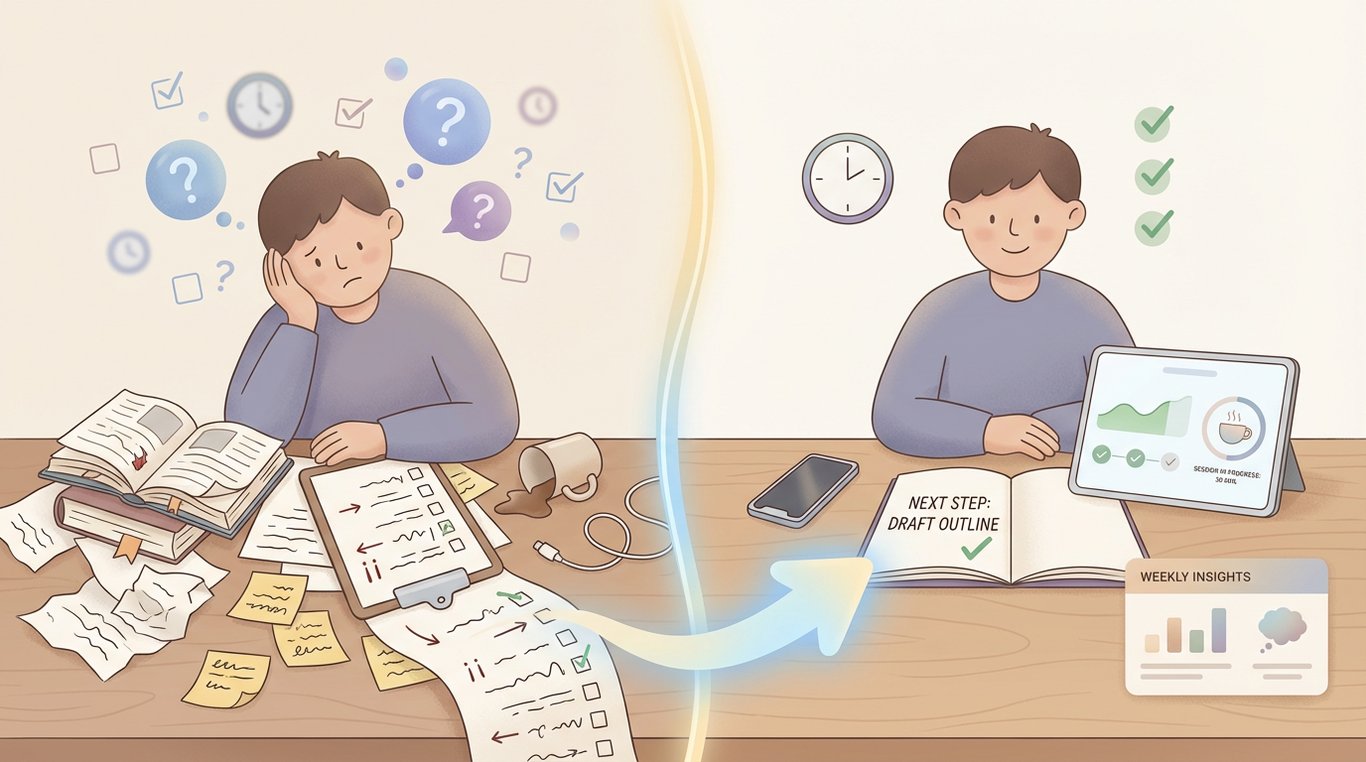 If your to-do list looks like a horror movie right now—unfinished assignments, exams creeping closer, and somehow you also have work/sports/life—listen:
You don’t need more apps.
You need a system.
And ideally, a coach inside that system.
Because there’s a big difference between a tool and a coach.
A tool is helpful when you already know what to do.
A coach is helpful when you don’t—or when you keep doing the “right thing” inconsistently because… you’re human.
Let’s break that down.
Tools help you do tasks. Coaches help you become better at doing tasks.
A basic timer is a tool.
A notes app is a tool.
A calendar is a tool.
They’re like kitchen equipment. A knife won’t teach you to cook. It’ll just… cut stuff.
A coach, though? A coach does four things tools don’t:
Understands your goal
Notices your patterns
Gives feedback that fits you
Adjusts the plan so you improve over time
That’s what “AI-powered focus coach” should mean in practice.
Not “it has a chatbot.”
Not “it tracks your streak.”
More like: it helps you build the skill of studying well, under real-life conditions.
Real life is messy. Most study advice isn’t.
Most study systems assume you’re a calm robot with unlimited time and perfect motivation.
But you’re dealing with:
“I’ll start after dinner” → dinner becomes a two-hour doom-scroll
A part-time job that randomly adds shifts
A teacher assigning surprise homework
A brain that panics when tasks are vague (“Revise biology” = stress)
Guilt spirals after one bad day
Here’s the truth: you don’t fail because you’re lazy.
You fail because your system can’t handle chaos.
A focus coach helps you build a system that expects chaos and still works.
Think of your study plan as a GPS, not a prison.
If you miss a turn, it doesn’t scream at you. It reroutes.
The loop that actually works: Planning → Scheduling → Focusing → Learning
This is the core workflow I teach students because it’s simple and it survives real life.
1) Planning: turn “stuff” into tasks that make sense
Planning is where you stop writing nonsense like “Revise chemistry” and start writing tasks your brain can complete.
Here’s what this looks like in practice:
Instead of:
“Study Macbeth”
Do:“Read Act 2, Scene 2 and write 5 bullet quotes + meaning”
“Plan 1 paragraph on theme of guilt (PEEL)”
This is where a tool like AriaPlanner’s Plan tab can make things easier: multiple plans (by exam or subject), start dates, and—crucially—dependencies.
Dependencies are underrated. They’re how you stop lying to yourself.
You can’t do:
“Past paper Q3”
before:“Learn the structure for Q3”
A coach catches that.
Tell Aria (template):
“I have a GCSE English exam in 2 weeks. I’m behind on Macbeth and I need to learn how to answer the 19th-century novel question. I can study 60–90 mins on weekdays, 3 hours weekends.”
A tool would store that.
A coach would turn it into a sequence.
2) Scheduling: put tasks onto real calendar time (not fantasy time)
Scheduling is where dreams meet Tuesday.
This is where most students break down because their “plan” floats in the air and never touches the calendar.
A coach helps you find actual slots, like:
4:30–5:05 after school (before you’re cooked)
7:30–8:10 on workdays
Saturday 10:00–11:30 (high-focus block)
AriaPlanner’s Schedule tab is one way to make this easier—especially when it can work around a busy life and integrate with Google Calendar. The point isn’t “more scheduling.” The point is less negotiation with yourself every day.
Because every time you ask, “When will I study?” you’re spending willpower.
Schedule once. Then follow the map.
3) Focusing: stop relying on motivation; use structure
This is where “AI-powered focus coach” really earns its name.
A basic timer just counts down.
A coach helps you finish.
What does that look like?
It suggests a session length that matches your energy
It helps you start when you’re resisting
It adapts when you finish early or get stuck
It reschedules the leftovers without making you feel like a failure
If you’ve used AriaPlanner’s Focus screen with the adaptive coffee cup timer, you’ll get the vibe: it’s not just “25 minutes, go.” It’s more like, “Let’s make progress, then adjust based on what actually happened.”
Here’s what this looks like in practice:
You planned 45 minutes of biology flashcards.
You finish in 30 because you were locked in.
A tool says: “Timer done.”
A coach says: “Nice. Want to pull forward a smaller task, or bank the time for later?”
Or:
You planned an essay.
You stall because you don’t know how to start.
A coach prompts: “Open a skeleton. Write the worst intro possible. We fix it after.”
Progress first. Perfection later.
4) Learning: weekly insights that make next week easier
This is the part almost nobody does—and it’s why students repeat the same painful week forever.
A coach helps you reflect like an athlete, not like a judge.
Not: “I’m so bad at focusing.”
But: “What conditions made focusing easier?”
This is where an Insights tab (like AriaPlanner’s) becomes more than graphs. It becomes coaching notes:
“You start strong on Mondays, crash on Wednesdays.”
“You underestimate essay tasks by 2x.”
“Your best sessions happen right after school, not late evening.”
“You avoid math when the task isn’t defined.”
And then it helps you adjust:
Here’s what this looks like in practice:
Next week, essays get split into: plan → 1 paragraph → 2 paragraphs → improve.
Math gets scheduled earlier in the day.
Wednesday becomes “light review + admin” instead of “hardest topic” day.
That’s coaching. It’s not motivational quotes—it’s iteration.
Philosophical truth: the future of learning isn’t more content. It’s better guidance.
You already have enough content:
YouTube explanations
Past papers
Notes
Flashcards
Teachers
Revision guides
The bottleneck isn’t information.
It’s:
picking the right next step,
doing it consistently,
and adapting when life punches your plan in the face.
An AI-powered focus coach (at its best) is basically a bridge between your intentions and your actions.
Not replacing you.
Not “studying for you.”
Just making the path clearer and the next move easier.
If you want to try this mindset today, do this 10-minute reset
No dramatic overhaul. Just a quick system reboot.
Step 1: Pick one goal (not five)
Example: “Biology mock in 12 days.”
Step 2: Break it into 6–10 concrete tasks
Example:
“List all topics on the spec I’m shaky on (15 min)”
“Cells: 30 flashcards (40 min)”
“Cells: exam questions + mark scheme (45 min)”
“Homeostasis: mindmap from memory (30 min)”
“Past paper #1 timed (60 min)”
“Error log + redo wrong questions (45 min)”
Step 3: Schedule the next 3 sessions only
Not your whole life. Just the next three.
Step 4: Run one focus session with a rule
Rule: Start ugly.
You’re allowed to do a bad first draft, a messy mindmap, a rough attempt. Momentum first.
Step 5: End with a 60-second reflection
What worked?
What blocked me?
What’s the next smallest step?
If you use something like AriaPlanner, this maps cleanly to Plan → Schedule → Focus → Insights. If you don’t, you can still run the loop manually. The loop is the magic, not the app.
Bottom line
A tool says: “Here’s a feature.”
A coach says: “Here’s your next move—and why you keep getting stuck—and how we fix it.”
That’s what an AI-powered focus coach should be.
Not hype. Not pressure. Not perfection.
Just a partner that helps you turn chaos into a workable system—one week at a time.
If you tell me what you’re studying, your exam date(s), and how many hours you realistically have this week, I’ll show you what the Planning → Scheduling → Focusing loop looks like for your situation.