
Study Anxiety vs. Study Uncertainty: How Clear Sequencing Reduces Stress
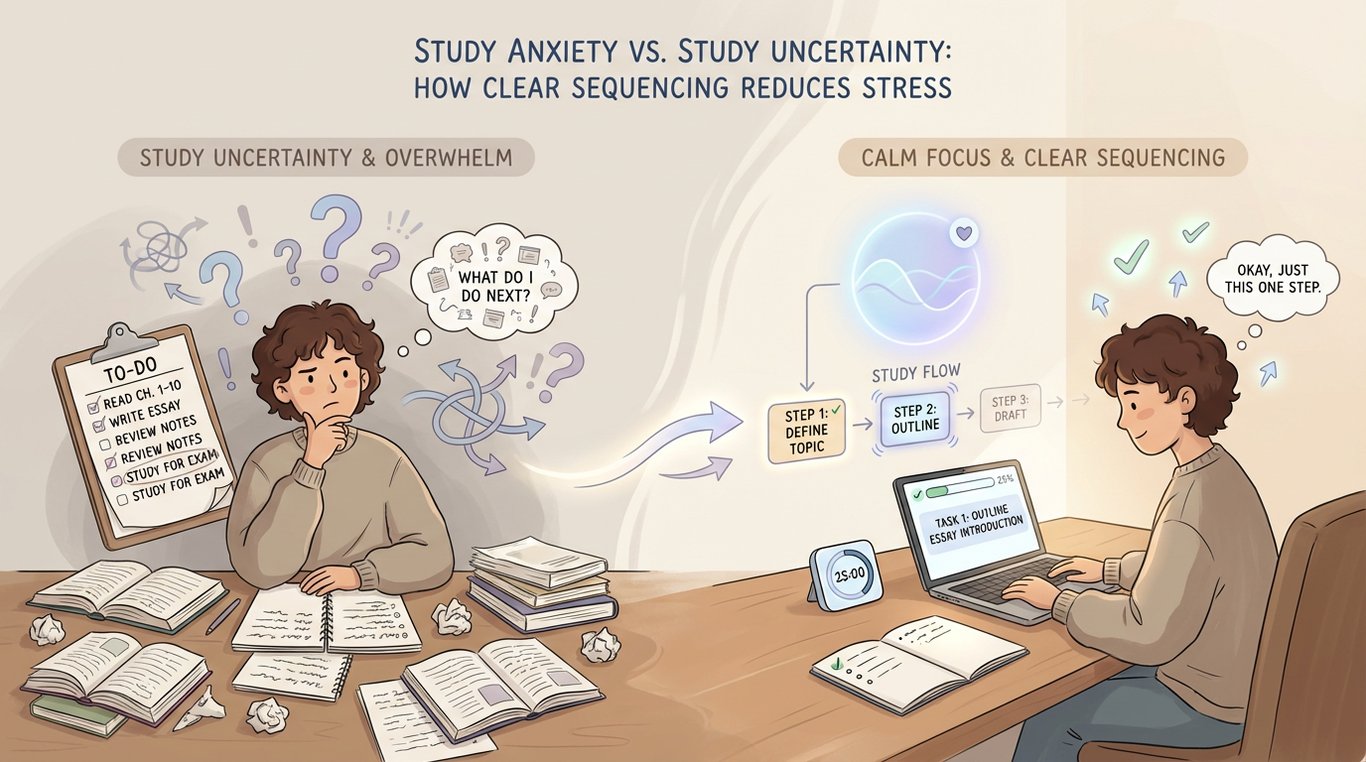 If your to-do list looks like a horror movie right now, let’s start with something important:
You are not always “bad at studying.”
Sometimes you’re just unclear.
And that unclear feeling? It often gets labeled as anxiety when a big part of it is actually uncertainty.
Not the same thing.
Anxiety says, “I’m stressed.”
Uncertainty says, “I don’t know if I’m doing the right thing, in the right order, at the right time.”
That second one matters more than most students realize.
Because when your brain doesn’t trust the plan, it doesn’t relax. It keeps scanning for danger:
Should I revise biology or maths?
Am I behind?
Is making flashcards a waste of time?
Should I finish notes first?
What if I’m focusing on the wrong topic?
That constant questioning is exhausting. Not because you’re studying so hard—but because you’re trying to decide every five minutes.
The hidden stressor: not knowing what comes next
A lot of students think stress comes from the amount of work.
Sometimes it does.
But very often, stress comes from lack of sequence.
When everything feels equally urgent, your brain treats everything like a fire alarm. You sit down to study, but instead of getting started, you do 20 minutes of low-level panic and “organising.” You open tabs. You rewrite the to-do list. You check the exam date again. You ask your friend what they’re revising.
You’re not lazy.
You’re stuck in ambiguity.
Think of it like this: studying without sequence is like trying to cook five dishes at once without knowing which one needs the oven first. You’re technically “busy,” but the whole thing feels chaotic because there’s no order holding it together.
Anxiety gets louder when the path is vague
Here’s the blunt truth: vague plans create emotional friction.
“Revise chemistry” is vague.
“Do something for history” is vague.
“Catch up on English” is vague.
Your brain hates vague.
Why? Because vague tasks give you no clear starting point, no finish line, and no proof that you’re making progress. So instead of feeling safe, your brain keeps asking: Am I missing something?
That question is fuel for stress.
A clearer plan reduces that stress because it answers the question before your brain has to keep shouting it.
What actually helps: dependencies and suggested next steps
This is where study systems make a huge difference.
One of the fastest ways to reduce uncertainty is to stop treating your workload like one giant pile and start treating it like a sequence.
That means asking:
What needs to happen first?
What can wait?
What depends on something else being done?
What is the next visible step?
This is the difference between:
“Revise GCSE English”
and
“Finish An Inspector Calls character quotes”
“Then answer one 20-minute essay on Sheila”
“Then mark it using the rubric”
“Then review weak analysis points”
See the difference?
The second version feels calmer because it gives your brain a path.
That’s what dependencies do. They turn studying from a foggy obligation into a followable route.
Think of your study plan like a GPS, not a prison. You do not need every second of your life mapped out. You just need to know where you are, what turn comes next, and what probably comes after that.
Here’s what this looks like in practice
Let’s say you’ve got:
a maths exam in 10 days
a part-time job on Tuesday and Thursday
football practice Wednesday
two unfinished science topics
one English essay hanging over your head like a cloud
Messy. Very normal.
A bad plan would be:
revise maths
revise science
do English essay
A better plan would be:
List each subject goal.
Break each goal into smaller tasks.
Add dependencies.
Put those tasks into actual time slots.
Focus on only the next task—not the whole mountain.
For example:
Maths
Identify weak topics from last test
Relearn simultaneous equations
Do 15 practice questions
Check mistakes
Redo missed question types two days later
Science
Finish cell division notes
Answer 10 retrieval questions
Review mark scheme
Complete one mixed-topic quiz
English
Re-read essay question
Build quick quote bank
Write paragraph plans
Draft intro + 2 paragraphs
Finish essay
Edit against rubric
Now add dependencies:
You can’t do effective mixed-topic science questions before reviewing the topic.
You probably shouldn’t write the English essay before building the quote bank.
You shouldn’t do more maths papers until you’ve diagnosed the weak areas.
Now your brain stops spinning because it can see the logic.
Why sequencing feels emotionally safer
This part matters.
A good sequence doesn’t just improve efficiency. It improves emotional safety.
When the next step is obvious, your brain uses less energy on self-doubt.
When tasks have an order, you stop second-guessing every study session.
When the work is mapped onto real time, your brain stops believing you must do everything tonight.
That last one is huge.
A lot of student panic is really this thought:
“There is too much, and I don’t know when it’s supposed to happen.”
Scheduling answers that.
Not with fantasy timetables. With real life.
Planning is not enough if it never reaches the calendar
This is where a lot of students fall off.
They make a nice list. Maybe even a colour-coded one. Then they never connect it to actual hours in an actual week.
So the plan still feels fake.
Planning says what matters.
Scheduling says when it will happen.
Both matter.
Here’s what this looks like in practice:
You look at your week.
You account for school, work, training, commuting, and basic human exhaustion.
Then you fit study blocks into the spaces that really exist.
Not the spaces you wish existed.
The ones that are real.
This is one reason a tool like AriaPlanner can help. Not because it magically makes exams easy, but because it’s one way to make the system easier to run.
In the Plan tab, you can break a big exam goal into subjects, tasks, and dependencies, with sensible start dates instead of one giant panic-list.
In the Schedule tab, you can map those tasks onto real open slots around your life, including your Apple Calendar, so your study plan actually meets reality.
That matters more than people think.
Because a task feels less threatening when it has a home.
The focusing problem: even good plans can fail without a good start
Let’s be honest: even when you know what to do, getting started can still feel weirdly hard.
That doesn’t mean the plan is bad.
It means starting has friction.
This is where short, defined focus sessions help. You are not promising to “study all evening.” You are just starting one clear block.
Small target. Lower resistance.
For example:
25 minutes: finish biology retrieval questions
20 minutes: plan English paragraph structure
30 minutes: maths practice set on one weak topic
That’s manageable.
AriaPlanner’s Focus screen is one example of how an AI-powered focus coach can support this. The adaptive coffee cup timer gives the session a shape, which sounds simple, but simple is good when your brain is overloaded. If you finish early, great—you can end the session and reschedule what’s next instead of forcing fake productivity.
That kind of flexibility matters.
Because again: GPS, not prison.
The real anti-anxiety loop: planning → scheduling → focusing → learning
This is the loop I wish more students were taught.
1. Planning
Break big goals into smaller tasks.
Make the order visible.
Add dependencies.
2. Scheduling
Put those tasks into real time.
Work around your actual life.
Protect realistic study blocks.
3. Focusing
Use one session for one task.
Reduce switching.
Let the session have a clear start and end.
4. Learning
Review what worked.
Notice patterns.
Adjust next week’s plan.
That last step is where confidence grows.
Because confidence is not “I feel amazing all the time.”
Confidence is: “I know how to adjust.”
Weekly reflection reduces future uncertainty
A lot of stress comes from repeating the same messy cycle without ever stopping to learn from it.
Maybe you always plan too much for Mondays.
Maybe your best focus block is actually 7:00–7:40 pm, not 4:00 pm after school.
Maybe flashcards feel productive, but exam questions are what actually move your scores.
You only catch that if you reflect.
Here’s what this looks like in practice:
What did I finish this week?
What kept getting delayed?
Which tasks took longer than expected?
When did I focus best?
What should I change next week?
AriaPlanner’s Insights tab is one way to support that review. End-of-week reflections, patterns, and coaching notes can help you spot where your system is working and where it needs adjusting. Not to judge you. To give you feedback.
That’s a big difference.
Judgment creates shutdown.
Feedback creates improvement.
A simple script you could use
If you’re staring at a giant workload and don’t know how to begin, keep it simple.
You could tell Aria:
“I have a GCSE English exam in 2 weeks, a maths test next Friday, and football on Wednesday evenings. Break this into small study tasks, show me what should come first, and help me fit it around my week.”
Or:
“I’m behind on biology and I keep avoiding it. Split it into tiny steps, add the right order, and schedule three short sessions for me.”
Or even:
“I feel stressed because I don’t know what to study next. Help me create a sequence for the next seven days.”
Notice what all three have in common?
They are not asking for motivation.
They are asking for clarity.
And clarity is often the first real relief.
If you feel anxious, don’t just ask “How do I calm down?”
Also ask:
What exactly am I uncertain about?
Which task feels unclear?
What decision am I repeatedly trying to make?
What needs to be broken down further?
What should happen first?
That question shift is powerful.
Because sometimes the fix is not breathing exercises, a new highlighter set, or another productivity video.
Sometimes the fix is:
Make the next step obvious.
Final thought
Study anxiety is real. I’m not dismissing that.
But a surprising amount of what students call anxiety is actually the stress of unclear sequencing. The work feels dangerous because the path feels foggy.
So don’t just try to “work harder.”
Make the route clearer.
Break the work down.
Show the dependencies.
Put it on the calendar.
Do one session at a time.
Review and adjust.
That is how studying starts to feel more controlled.
More doable.
Safer.
And when your brain trusts the plan, it finally stops treating every revision session like an emergency.