
The “Next Action” Rule: Why Knowing the Next Actionable Task Beats Motivation
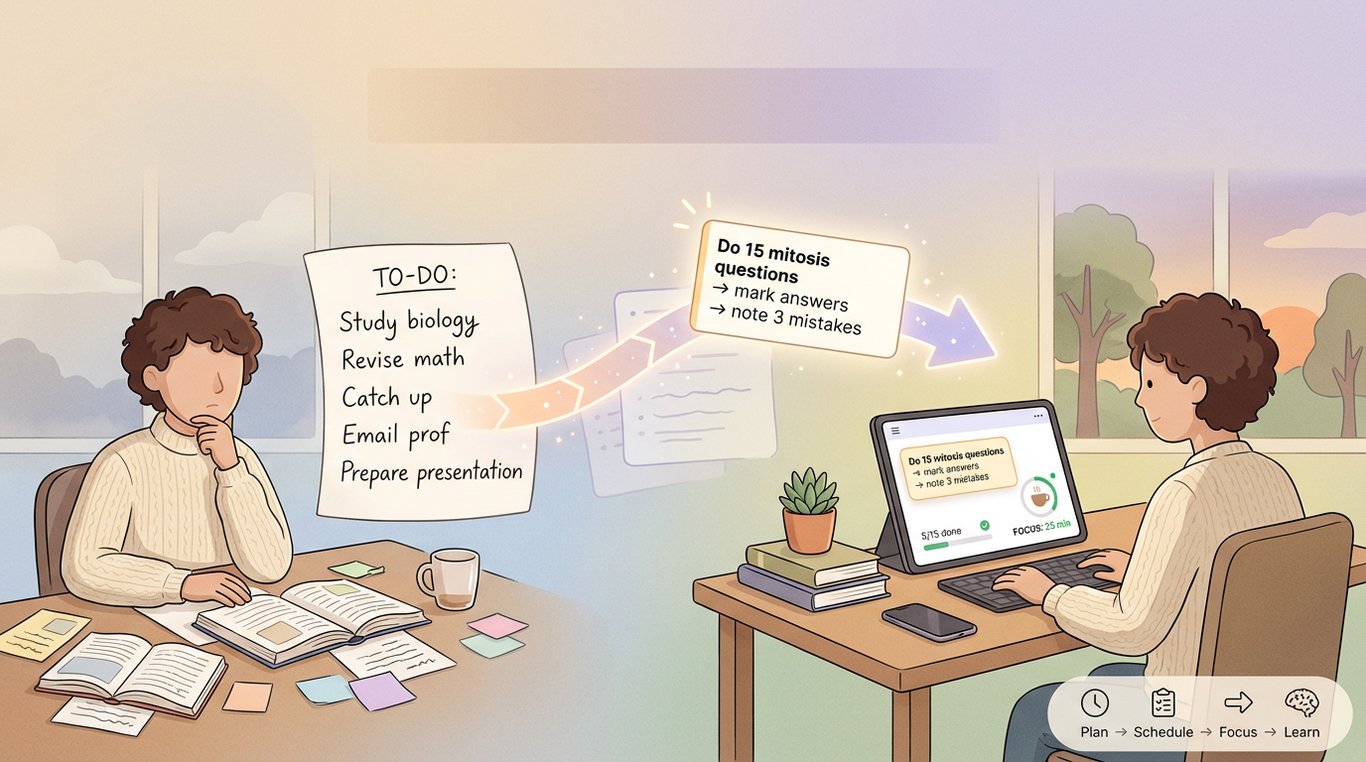 If your to-do list looks like a horror movie right now—Study biology. Revise math. Catch up on English. Be productive.—you’re not lazy.
You’re just trying to execute vague tasks.
And vague tasks are motivation killers.
Because your brain doesn’t fail at effort.
It fails at decisions.
The core idea
The Next Action Rule: If you always know the next actionable task, you don’t need to “feel motivated.” You just need to start.
Think of it like this:
Vague task: “Study biology.”
Your brain immediately asks: Where do I start? Notes? Videos? Past papers? Which topic? How long?
That’s a mini-meeting in your head. Exhausting. You delay.Next action: “Do 15 mitosis questions from Topic Pack B. Mark with the scheme. Log mistakes.”
Your brain goes: Cool. I can do that.
No negotiation. Just movement.
Motivation is unreliable. Systems aren’t.
Why vague tasks drain you (decision fatigue, not discipline)
When a task is fuzzy, you have to decide everything:
what “counts” as studying
what resource to use
what topic is highest priority
how long to do it
what to do if you get stuck
That’s decision fatigue. And it stacks up—especially if you have:
exams in multiple subjects
a part-time job
training, practice, family stuff
a phone that exists
So you sit down… and your brain goes: Nope.
Not because you can’t work—because the “start” is unclear.
Actionable filtering fixes that. You turn “big scary” into “next small.”
Here’s what this looks like in practice
Step 1: Convert vague → actionable (in 60 seconds)
Take any vague task and force it through this filter:
A task is actionable if it answers:
What exactly am I doing?
How many / how long?
What does “done” look like?
What do I do immediately after? (optional but powerful)
Examples:
“Revise chemistry” → “Complete 20 moles questions (mixed), check answers, write 5 error-flashcards.”
“Work on English” → “Write 1 intro + 2 body paragraphs for the ‘Power and Conflict’ essay, then self-mark using the rubric.”
“Do math” → “Watch 8-minute trig identities recap, then do Q1–Q12 from worksheet, circle any you can’t start.”
Notice the vibe: specific, measurable, finishable.
The secret upgrade: dependencies (a.k.a. why you get stuck mid-session)
A lot of “procrastination” is actually blocked tasks.
Example:
“Do 15 mitosis questions” is blocked if you don’t have the question pack.
“Write the essay” is blocked if you haven’t picked a question or don’t know the quotes yet.
“Past paper” is blocked if you haven’t learned the topic basics.
This is where a planning system becomes a GPS, not a prison.
Planning → Scheduling → Focusing → Learning loop (the sane way to study)
1) Planning (break goals into tasks + dependencies)
You’re building a chain:
Learn basics → do practice → mark → fix weak spots → re-test
In AriaPlanner’s Plan tab, this is where you’d:
create a plan per exam (or per subject)
add tasks like “Mitosis basics video” → “Mitosis Qs set 1” → “Corrections + flashcards”
set dependencies so you don’t pretend you can do Step 3 before Step 1
Here’s what this looks like in practice:
Task: “Mitosis Qs Set 1 (15 Qs)”
Depends on: “Mitosis notes + examples (20 min)”
That dependency alone saves you from the classic sit-down-and-stare session.
2) Scheduling (map tasks onto real life)
Your schedule is not infinite. It’s a tight suitcase.
In AriaPlanner’s Schedule tab, you’d find realistic slots:
45 minutes before practice
30 minutes after dinner
90 minutes on Saturday morning
And if you use Apple Calendar, syncing helps you stop “planning in fantasy land.”
3) Focusing (one task, one session, start now)
When it’s time to work, you don’t need a menu of choices. You need one clear next action.
That’s why systems that suggest a single next task are so effective: they cut the decision tree.
AriaPlanner’s Focus screen does something similar:
it nudges you toward what’s unblocked and high-impact
if something is blocked, it’s locked/disabled so you’re not wasting willpower trying to start the impossible
an adaptive timer (the “coffee cup” vibe) keeps the session contained—long enough to matter, short enough to start
If you finish early? Great. You don’t “scroll as a reward.”
You reschedule the remaining time or pull the next small action.
4) Learning (weekly insights, not weekly guilt)
Most students repeat the same week because they never review what happened.
In AriaPlanner’s Insights tab, the point isn’t judgment—it’s pattern spotting:
“I keep scheduling heavy tasks after work—no wonder I avoid them.”
“I start strong on Monday, crash on Thursday.”
“My ‘reading’ tasks take 2x longer than I estimate.”
Then you adjust the system. Like a coach would.
A simple template: the “Next Action” rewrite
When you’re stuck, rewrite your task like this:
Verb + number/time + resource + finish line
Examples:
“Do 15 mitosis questions from Topic Pack B, mark, write 3 ‘why I missed it’ notes.”
“Spend 25 min on Anki Bio Deck: Cell Division, stop when timer ends.”
“Complete Q1–Q10 from 2019 Paper 2, then log errors in mistake sheet.”
If you can’t write it like that, you don’t have a task—you have a wish.
Sample scripts you can literally type (messy life edition)
If you’re overwhelmed:
Tell Aria:
“I have 3 exams in 2 weeks, I work Tue/Thu evenings, and I’m behind on biology and math. Build me a plan with dependencies and give me one next task per session.”
If you keep procrastinating one subject:
Tell Aria:
“I avoid chemistry. Break it into tiny actionable tasks under 30 minutes, schedule them around my practices, and suggest the next unblocked task when I open Focus.”
If you never know what to do when you sit down:
Tell Aria:
“When I study, I freeze because tasks are vague. Rewrite my tasks into clear next actions with a definition of done.”
AriaPlanner is just one way to make this easier—but the rule works anywhere: notebook, Notion, sticky notes, whatever.
Your challenge (takes 5 minutes)
Pick 5 items from your current to-do list.
For each, turn it into a next action:
make it specific
make it finishable
make it unblocked (or add the unblock step first)
Then do one of them for 10 minutes today.
Not because you’re motivated.
Because it’s clear.
That’s the whole game: clarity → start → momentum.
If you want, paste 5 of your current vague tasks here (exactly as written), and I’ll rewrite them into clean next actions—with dependencies and a realistic schedule option.