
The “Perceptual Time” Trick: Why Some Study Sessions Drag and Others Vanish
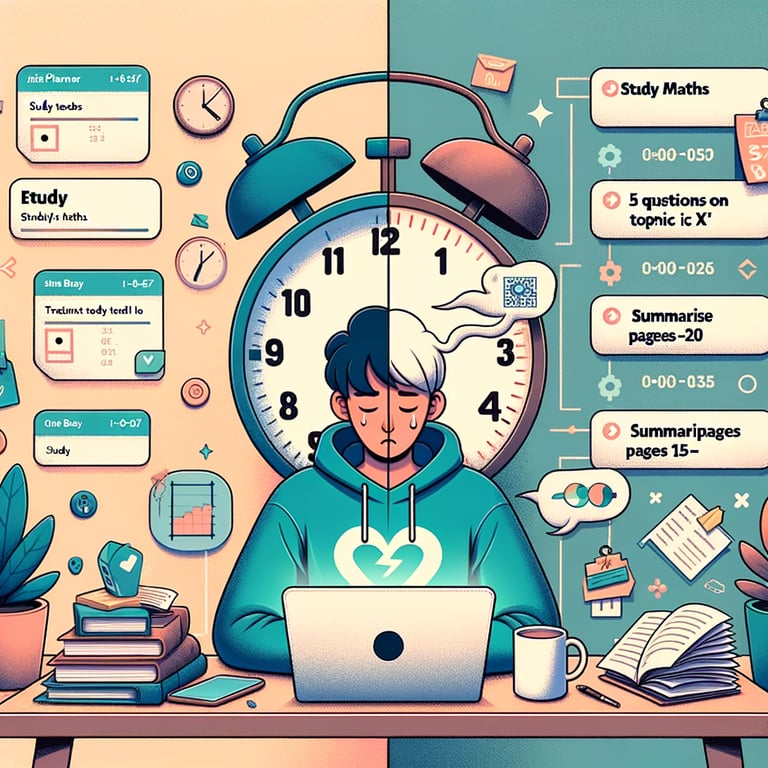 You know that feeling when you “study” for 20 minutes and it feels like an hour…
but then you game, scroll, or talk to a friend and suddenly two hours are gone?
Same amount of time. Completely different experience.
This is about that gap: how your brain feels time vs how the clock measures it—and how you can quietly cheat that system so study blocks don’t feel so brutal.
I’ll also explain why some apps now use soft, visual timers instead of giant countdown numbers—and why that isn’t just a design gimmick.
Why Watching a Countdown Timer Feels So Bad
Picture the classic setup:
You set a 25‑minute Pomodoro timer.
At 23:41 you check it and think: “I’m already tired.”
At 19:10 you check again: “Why is this going so slowly?”
At 15:32 you’re in that weird limbo where you’re:
half‑reading,
half‑watching the timer,
half‑judging yourself (yes, that’s three halves).
By the end, you’ve technically done 25 minutes, but it feels like you just did hard labour for 50.
What’s going on?
The timer is framed as loss.
Every second is something being taken away. Your brain is basically watching time drip out of your life.You’re running two processes at once.
You’re not just “studying.” You’re:studying
monitoring time
evaluating yourself in real time
That extra load makes everything feel heavier.
You unintentionally poison the ritual.
If “open timer → feel pressured → feel inadequate” happens often enough, your body starts to resist the whole idea of “starting a session.”
The result: the timer does its technical job, but it makes study time feel long, tense, and unpleasant.
The goal isn’t to ditch timers altogether.
The goal is: stop designing them like tiny anxiety machines.
How Your Brain Actually Experiences Time
There are basically two clocks involved when you work:
Clock time – what your phone or laptop says.
Perceived time – how long it feels.
They don’t match.
Rough patterns:
Bored, confused, or uncomfortable? Time stretches.
Five minutes of staring at the same paragraph feels like twenty.Engaged or slightly challenged? Time compresses.
When you’re into something, an hour can feel like ten minutes.Constant self‑checking makes time crawl.
If you keep asking, “How much is left?” or “Am I doing enough?”, you pull attention away from the task and into self‑monitoring. That slows everything down subjectively.
So:
30 minutes on social media can feel like 5.
30 minutes on dense notes can feel like 90.
You can’t change physics, but you can change how those minutes feel. That’s the whole idea behind “perceptual time.”
What “Perceptual Time” Actually Is (Without Jargon)
Forget the fancy term for a second. This is all it means:
Perceptual time = how fast or slow time seems to pass, depending on your mental state.
It speeds up (in a good way) when:
You’re absorbed in one clear task
You see or feel progress
You’re not yanked out by constant clock‑checking
It slows down when:
You’re anxious, bored, or overwhelmed
The task is vague (“study chemistry”)
You’re watching the timer like a hawk
The key shift is:
Don’t just choose how long to study.
Design sessions around how you want those minutes to feel.
That’s where timer style and task design actually matter.
Why Soft Visual Timers Often Work Better Than Giant Numbers
A lot of newer focus tools are moving away from shouting “24:59… 24:58… 24:57…” and toward softer visuals: a coffee cup filling, a ring completing, a bar slowly growing.
That’s not just about aesthetics; it’s quietly messing with your perceptual time in your favour.
1. Progress vs. Loss
Countdown:
“You are losing time.”
Filling bar / cup:
“You are building progress.”
It’s the same 25 minutes, but your brain reads them differently:
One is a resource drain.
The other is a visible accumulation of effort.
Watching something fill up feels a lot less punishing than watching numbers tick down to zero.
2. Deliberate Vagueness
A big “23:17” invites obsession.
A subtle visual—like a cup halfway full—tells you roughly:
You’re somewhere in the middle.
You’ve already done some.
You’re not done yet.
You don’t feel compelled to track every second. That bit of fuzziness helps you stay in the task instead of in “how long is left?” mode.
3. Room for Adaptation
When the timer isn’t screaming numbers at you, it can also adapt quietly:
If you regularly end early feeling “I’m done,” it can shift your default block slightly shorter.
If you often extend happily, it can stretch things a bit.
If certain sessions are always rough, it can suggest smaller chunks.
Some apps (like AriaPlanner with its coffee‑cup timer) are built around this idea: sessions are tuned over time to feel more like your natural “sweet spot” and less like an arbitrary 25/50‑minute rule.
You don’t see a big announcement about this. You just gradually notice: “Huh, these blocks are more tolerable than they used to be.”
A Realistic Before‑and‑After: Same Student, Different Setup
Take Alex, revising for exams.
Version 1: Countdown Prison
He sets a 30‑minute timer.
Writes on his list: “Study Biology.”
What happens:
Minute 4: He’s reading the same sentence.
Minute 9: He checks the timer. “21:03 left. Feels like I’ve been here for half an hour already.”
Minute 14: He opens his phone “for a second.”
Minute 30: Timer goes off, he’s halfway through something and feels both tired and guilty.
From the outside, 30 minutes of study.
From the inside, 30 minutes of slow, sticky time and self‑criticism.
His brain quietly logs:
“Biology + timer = awful.”
Version 2: Same Subject, Different Design
New approach:
He breaks things into concrete chunks:
“Review diagrams for topic X and note 3 key points.”
“Do 5 past questions on topic X.”
“Summarize topic X in 6 bullet points.”
He starts a small, visual timer (could be a filling cup, ring, subtle bar) for just one of those chunks.
Now:
He sees the timer at the start → okay, just beginning.
He focuses on that one defined task.
He glances back later → it’s partway through, he’s clearly made progress.
If he finishes the chunk slightly early, he stops instead of forcing himself to sit until the last second.
The feeling afterwards is different:
He finished something.
The time didn’t drag as much.
The “study ritual” stings less.
Same subject, similar overall minutes. Very different emotional weight.
How to Hack Perceptual Time in Your Own Study Sessions
You don’t need any special app to start using this (though a decent one can help). Here’s a simple way to put it into practice.
1. Stop Studying “Subjects”; Study Chunks
“Study physics” is a swamp. Your brain sees no clear end point.
Turn it into small, do‑able chunks like:
“Redo 4 past‑paper questions on motion.”
“Summarise pages 10–15 in my own words.”
“Make flashcards for 10 key definitions from topic X.”
When the task is concrete:
Progress is obvious.
Your brain can see “before → after” within one session.
Time tends to feel faster because you’re actually moving through something.
If you do use a planner (digital or paper), this is the stage where you break big goals into those smaller chunks instead of writing “REVISION” 50 times.
2. Use Time as a Container, Not a Threat
Before starting, try framing it like:
“For the next 20–30 minutes, this is my little container for focus.
I don’t have to be perfect. I just have to stay inside it.”
Then:
Use a visual / low‑key timer rather than a huge, ticking countdown.
Don’t make the timer the main thing on your screen.
If you genuinely finish the chunk early, you’re allowed to stop. It still counts.
That flips it from:
“I’m trapped until the timer frees me.”
to:
“I chose this block to focus, and then I’m done with this piece.”
Small mental shift, big difference in how long it feels.
3. Notice the Feel, Not Just the Duration
After each block, quickly check in:
Did that feel:
like it dragged forever?
neutral?
pretty manageable / faster than expected?
You can log this in a planner, rate it in an app, or just note it mentally: “Maths, 25 min, felt OK.”
Patterns over a week are more important than any single session:
Maybe mornings feel lighter than late nights.
Maybe 20 minutes is fine but 45 minutes always hurts.
Maybe certain topics only feel awful when you try to do them in one huge chunk.
This is your personal “perceptual time map.” Use it to design your schedule.
4. Adjust in Notches, Not Leaps
Instead of vowing to suddenly do 2‑hour deep‑work marathons:
If 20‑minute blocks feel consistently okay, try 25 next week.
If 40‑minute blocks regularly wreck you, drop to 30 and cut the task in half.
If late‑night study always drags, shift heavier work earlier and leave evenings for review / easier subjects.
Some tools (including AriaPlanner) are designed to adapt like this automatically over time. But even if you’re just noting things on paper, the principle is the same: slightly challenging, not punishing.
A 5‑Day Experiment to Test This on Yourself
If you want to see whether this actually changes anything for you, try this small experiment.
Day 1: Break One Thing Down
Pick one area you care about right now:
An upcoming exam
A project
A set of lectures you’re behind on
Spend 10–15 minutes turning that into small, concrete tasks that fit in 20–30 minutes each.
Write them down clearly.
Day 2–4: Run “Soft Timer” Sessions
Each day:
Pick 1–2 of those small tasks.
Set a timer for 20–30 minutes, but make it:
visual if possible (filling cup, ring, bar), or
at least out of sight (phone face‑down, no giant countdown visible).
Focus on just that one chunk.
When the block ends or the chunk is done, stop.
Quickly rate how it felt: dragged / meh / okay.
Day 5: Look for Trends
Ask:
Which blocks felt fastest?
Which times of day were easier?
Which types of tasks were consistently heavy?
Then adjust next week:
Put hard subjects into the times that felt lighter.
Use your most comfortable block length as your default.
Keep tasks small enough that “done” actually happens inside one block.
The Point
You can’t slow down real time, but you can:
Make tasks smaller and clearer
Use timers that show progress instead of pure countdown
Pay attention to how sessions feel and adjust based on that
Let your system (or your app) adapt to you, instead of forcing yourself into an abstract “ideal”
Perceptual time is the quiet lever here: if your study blocks feel less like a prison sentence and more like manageable containers, you’re much more likely to come back tomorrow.
You don’t have to love studying.
But if you can make it stop feeling like it lasts forever, consistency becomes a lot more realistic—and that’s where the real gains come from.