
Your Calendar Is a Constraint, Not a Suggestion: How to Plan Around Real Life
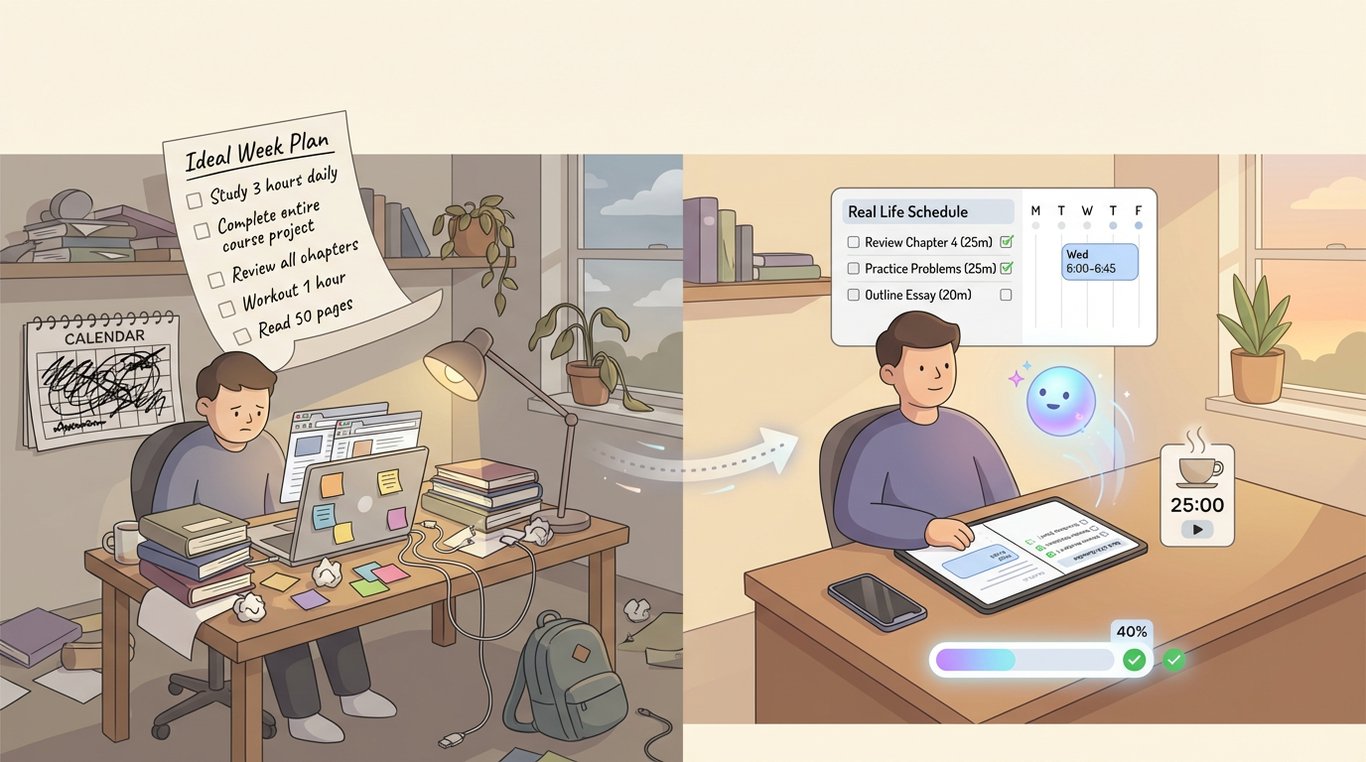 If your to-do list looks like a horror movie right now—10 chapters, 3 assignments, a mock exam, and somehow you’re also meant to be a functioning human—this is for you.
Because here’s the truth most study advice skips:
You don’t have a time-management problem. You have a reality-ignoring plan.
Most students build an “ideal week” schedule like:
“Study 3 hours after school.”
“Wake up at 6am every day.”
“Do 2 past papers every night.”
And then real life hits:
practice runs late
your shift gets extended
the commute eats an hour
you’re tired (because you’re a person)
…and the plan collapses.
So let’s fix the root issue.
The identity you need to adopt
Your calendar is a constraint, not a suggestion.
Your commitments aren’t “obstacles” to a plan.
They are the plan.
Think of your study system like a GPS, not a prison:
A GPS doesn’t pretend traffic doesn’t exist.
It routes around it.
And it reroutes when things change.
That’s how your study plan should work.
Step 1: Stop planning the week you wish you had
Most “ideal week” plans are basically fantasy novels.
Instead, build a plan that assumes:
You will have low-energy days.
Some evenings will get wrecked.
You will need downtime.
You will not study perfectly.
You’re not building a plan for the best version of you.
You’re building it for the real you—busy, human, and still capable.
Here’s what this looks like in practice:
The “Reality Inventory” (10 minutes)
Open your calendar (or a piece of paper) and list:
Fixed commitments: school/college, work shifts, sports, family obligations
Hidden time costs: commute, meals, chores, shower, admin tasks
Non-negotiable recovery: downtime, sleep, decompression
Then say it plainly:
“This is my available study time. Not my imaginary time.”
That’s your baseline.
Step 2: Plan first. Schedule second. (Most students do it backwards.)
A lot of students jump straight to scheduling:
“Monday 6–8pm: Biology.”
But they haven’t decided what “Biology” means.
That’s why they sit down and freeze.
So we do it in this order:
Planning = breaking goals into tasks (with dependencies)
Instead of “Revise Biology,” write tasks like:
Read Topic 3 notes (45 min)
Make flashcards for Topic 3 (40 min)
Quiz flashcards (20 min)
Do Topic 3 exam questions (45 min)
Mark + error log (25 min)
Dependencies matter.
You can’t “do exam questions” if you haven’t covered the content.
Here’s what this looks like in practice using AriaPlanner’s Plan tab (or any system that supports structured plans):
Create a plan: “GCSE Biology — Paper 1 (2 weeks)”
Add subjects/topics
Add tasks with realistic durations
Link dependencies (e.g., “Exam Qs” depends on “Notes + Flashcards”)
Add start dates so it doesn’t all pile into the last three days
Scheduling = mapping those tasks onto real calendar time
Now—and only now—you open your calendar and ask:
“Where are the real slots?”
Not “where should I study,” but “where can I study without ruining my life?”
In AriaPlanner’s Schedule tab, this is the whole point: it cross-references tasks with your availability (and can integrate with Apple Calendar) so you’re scheduling into existing reality, not fighting it.
Step 3: Use “slots,” not “marathon sessions”
The biggest scheduling lie students tell themselves is:
“I’ll do a 3-hour block on Wednesday.”
No you won’t. Not consistently.
Real life likes shorter, sturdier building blocks.
Try this instead:
30–45 min focus slots on weekdays
1–2 deeper sessions on weekends (if available)
buffer time built in on purpose
Here’s a simple template:
The “Busy Student Schedule” Template
Weekdays
Slot A (after school): 35 minutes (light task)
Slot B (evening): 45 minutes (main task)
Weekend
90 minutes (past paper + marking)
45 minutes (fix weak areas)
If you do sports or work, your weekday slots might be:
25 minutes before school, or
40 minutes right after dinner, or
30 minutes during a free period
The point: use what exists.
Step 4: Focus like a pro: make starting automatic
Scheduling is useless if you sit down and scroll for 40 minutes.
This is where a focus system matters.
A simple rule:
Your study sessions need a start button.
Here’s what this looks like in practice with AriaPlanner’s Focus screen:
You start a session and the adaptive “coffee cup” timer guides the block
If you finish early, you bank the win (don’t invent extra work out of guilt)
If you don’t finish, it helps you reschedule instead of spiraling
That’s the real game: finish, adjust, continue.
Not “be perfect.”
A script you can use before every session
Write this at the top of your page:
Task: (one specific thing)
Done looks like: (one measurable outcome)
Next step if I finish early: (tiny bonus task)
Example:
Task: “Topic 3 exam questions Q1–Q6”
Done looks like: “Answers complete + marked + 3 mistakes logged”
Next step: “Review 10 flashcards”
Step 5: Weekly insights (the part everyone skips)
Most students plan, fail, and then blame themselves.
High performers plan, review, and adjust.
Once a week (Sunday night or Friday afternoon), do a 10-minute reset:
The “Reality Review” (10 minutes)
Ask:
What consistently stole my time this week?
Which tasks took longer than I expected?
When did I focus best?
What should I schedule less of / more of?
If you’re using AriaPlanner, this is where the Insights tab helps—patterns, reflections, coaching notes—so you’re not guessing. You’re improving your system based on evidence.
This closes the loop:
Planning → Scheduling → Focusing → Learning → better Planning
That’s how you stop starting over every Monday.
A realistic example (because you need one)
Let’s say you’re:
in school 8:30–3:30
sports Tue/Thu 5–7
part-time job Sat 10–4
commute 45 min each way
you’re exhausted by 9:30pm
An “ideal week” plan says:
“Study 3 hours a day.”
A real plan says:
Mon: 45 min (light content)
Tue: 30 min (flashcards only)
Wed: 60 min (harder tasks)
Thu: 30 min (quick quiz + error log)
Fri: OFF or 25 min catch-up (depending on energy)
Sat: OFF (work day)
Sun: 2 hours (past paper + marking + fix list)
That’s not lazy. That’s strategic.
That’s how people actually finish syllabuses while having a life.
“Tell Aria” templates you can copy
If you want a starting point for an AI-powered workflow (again: one way to make this easier), try prompts like:
1) Build the plan
“I have a GCSE English exam in 2 weeks. I have sports Tuesday and Thursday evenings and a shift Saturday 10–4. Break revision into tasks with dependencies, estimate times, and prioritize the highest-impact tasks.”
2) Schedule around reality
“Here’s my availability: Mon 4:30–5:30, Tue 7:45–8:20, Wed 6–7:15, Thu 8–8:40, Sun 2–4. Schedule my tasks into these slots and keep sessions under 60 minutes.”
3) Adapt when life happens
“I missed Wednesday’s session. Reschedule the unfinished tasks into the next available slots without overloading Thursday.”
4) Weekly review
“Based on what I completed this week, what should I adjust next week? Give me 3 changes that make the plan more realistic.”
The bottom line
If you take one thing from this, take this:
A good study plan doesn’t demand more discipline.
It demands more honesty.
Your calendar isn’t a mood board.
It’s the playing field.
Plan the work.
Schedule it into real life.
Focus in small, winnable sessions.
Review and adjust weekly.
That’s how you stop feeling behind all the time—and start feeling in control.